

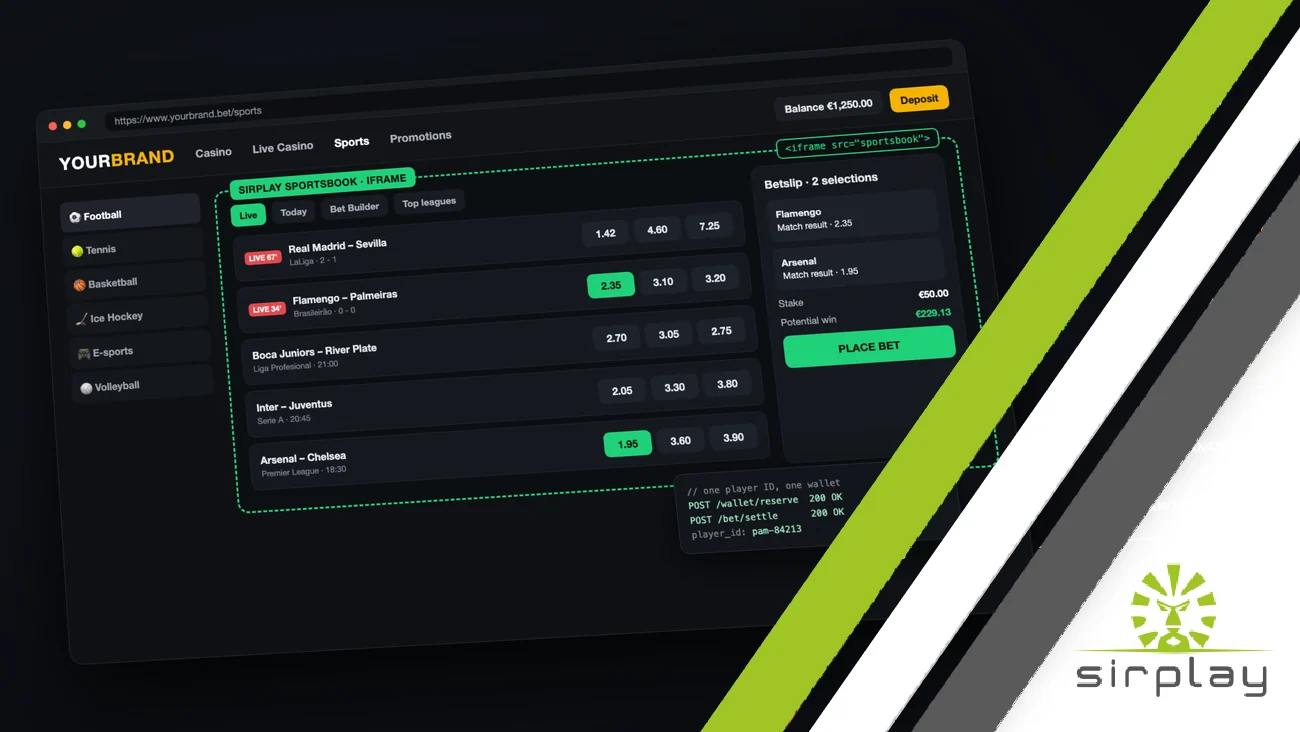
White label vs turnkey vs iframe is a deployment choice, not three different products. Turnkey is a full site, white label is the branded package you operate, and an iframe drops the sportsbook or casino into a player account system (PAM) you already run. An API is the fourth path: the same engines, with the front end on your own stack.
Key Takeaways
- White label, turnkey, iframe and API are delivery models for the same sportsbook engine; none of them is a gambling licence.
- An iframe is usually the smallest change for an operator that already runs accounts, wallet and KYC.
- A founder without a site is buying a storefront: white label or a turnkey site, not an embed.
- Whatever the model, the operator keeps the licence, KYC/AML and responsible-gambling duties in each market.
- Choose the path by who must control the player ID, the wallet and the data after the contract ends.
Table of contents
- Who this is for
- What is the difference between white label, turnkey and iframe?
- Which model fits an operator that already has a PAM?
- Which model fits a founder without a site?
- Does the model change who holds the licence?
- How the four paths compare
- What Sirplay does, and what the operator must do
- What to put in the demo scope
- Questions operators ask
Who this is for
Two buyers. An operator that already runs a PAM, a casino or a retail book and wants sports betting software without replacing the account layer. And a Web3 or crypto founder without a player account system, who needs a brand, a wallet model and a lawful route to market. If a model does not help one of those decisions, it does not belong in the shortlist.
What is the difference between white label, turnkey and iframe?
Vendors swap these labels. A page that says “turnkey sportsbook” may mean a branded skin, a full website or a managed trading service. The only stable reading is the contract schedule: who hosts the site, who holds the player ID, who settles the bet, and who holds the licence in the target market.
Sirplay draws the line this way. A white label betting platform is a ready sportsbook and casino stack you brand as yours: Sirplay runs the platform, odds, risk tools and launch support, and you own the brand and the players. Turnkey is the full site around that package. The iframe is the embed into a PAM you already operate. A configured white-label stack can go live in about 10 working days once brand assets and market scope are clear; the licence in the target country is never inside that clock.
The API sits beside the iframe. The sportsbook can be integrated as a full service, as sports betting only, or as casino and live casino, through iframe or API. Use API when your front end, pages and product logic must stay in-house. Use iframe when speed matters and the betting screen can live in a frame.
Which model fits an operator that already has a PAM?
If the account, wallet, KYC file and responsible-gambling limits already exist, an iframe is usually the smallest change. The browser loads the sportsbook inside a route you control. Odds, live betting and the betslip run on the vendor side. Your header, cashier and player ID stay where they are.
The real work is the bridge between the two systems:
- one shared player identifier between your PAM and the sportsbook;
- a wallet flow that reserves the stake, settles the bet and pays out on your balance;
- a content-security policy and session handling that allow the frame on your domain;
- limits and self-exclusion that the frame reads from your PAM, not from a second account.
A full white label or turnkey site is the wrong default for this operator unless the current PAM is being retired. Rebuilding accounts around a new storefront costs more than the embed and sends player data through a second migration. Casino, live casino, virtuals, e-sports and poker can be added later, once the same player ID is agreed. Two frames with two logins is not one book.
Choose API instead of iframe when the brand needs the betting pages on its own templates, or when the search and product teams must own every URL. It is more engineering. It does not remove the odds feed, the risk tools or the settlement rules; it only moves the front end.
Which model fits a founder without a site?
A founder without a PAM is buying a storefront, not an embed. White label is the branded package: domain, logo, languages, currencies and a configured sportsbook, often with casino. Turnkey is the full site around that package. The practical test is the same for both: can the team launch a brand without hiring a platform squad, and is the licence path for the first market already known?
Crypto does not change the split. A crypto sportsbook accepts coins, often into a custodial cashier; a Web3 setup may connect an external wallet. Sirplay has offered crypto payments since 2017 and Web3 wallet integration since 2021. A wallet connection does not make a book decentralised, and it does not replace a gambling licence. Optional no-KYC modules are a product setting, not an instruction to skip AML where the regulator requires checks.
Machiavelli advised the prince to build on what is in his own power, not on the goodwill of others. In platform terms that means the player file, the merchant of record and the brand after termination. “You own the players” is a commercial line: write the export format, the notice period and who may contact players after the contract into the schedule.
Does the model change who holds the licence?
No. Iframe, API, white label and turnkey are integration shapes. None of them is permission to offer gambling. Under Sirplay’s platform terms, gambling, payment and corporate licences in each target market sit with the operator, together with geo-blocking, age-gating and responsible-gambling configuration. Sirplay provides licensing support, not the licence.
In Great Britain, the Gambling Commission’s guidance on third-party relationships (updated November 2024) says compliance of all gambling websites, including white-label sites, sits with the licence holder and cannot be transferred. That is a British rule for a stated period, not a world rule. Some international setups run a brand under a provider’s B2C licence, and only in the markets that licence covers. Read the market and the date; do not treat a contract label as a portable licence.
How the four paths compare
| Path | What you take | Front end | Best fit |
|---|---|---|---|
| White label | Branded package: platform, odds, risk tools, launch support | Provider templates, your brand | New brand, limited engineering |
| Turnkey | Full site around that package | Provider site, your domain and brand | Founder who needs the whole storefront |
| Iframe | Sportsbook or casino embedded in your current PAM | Your site, vendor frame | Operator with accounts and wallet already live |
| API | Engines wired to your own interface | Your templates | Team that must own pages and product logic |
| Add-on only | Casino, live casino, virtuals, e-sports or poker on the same player ID | Whichever path the core book uses | Book that has already solved identity |
Live betting, bet builder and exposure limits belong in the sportsbook scope whichever row you pick; they are not a reason to choose iframe over API. Sirplay’s sportsbook covers 150,000+ pre-match and 100,000+ live events per month, with Nash AI risk management. Review them in a demo: a named tool is not a trading result.
What Sirplay does, and what the operator must do
Sirplay supplies sportsbook, casino, crypto and Web3 modules, integration and related B2B services. It does not accept player bets on sirplay.com. Platform IP stays with Sirplay, except the brand assets the client supplies. The sportsbook is multi-lab certified (GLI and BMM); a regulator may ask to see the certificate, its scope and its date.
The operator holds and maintains the gambling, payment and corporate licences in each target market, configures geo-blocking, age-gating and responsible gambling, and runs player KYC and AML where the regulator requires them. Marketing and consumer-facing terms sit with the operator. Player funds and payment-institution duties sit with the operator or its payment partners.
Licensing support, odds feeds, fiat and crypto payments, hosting and monitoring are services, not a substitute for the licence. Nothing in the integration model guarantees GGR, and winnings coverage exists only if it is separately written into the contract.
What to put in the demo scope
A demo request is a request: the team comes back within 24 hours to agree date, time and scope. Use the session to test the path you will actually launch.
- Name one primary path: white label, turnkey site, iframe or API.
- Name the first market and who will hold the licence there.
- If a PAM exists, show the player ID, wallet events and responsible-gambling limits the frame or API must share.
- List the modules in production for that contract: sportsbook, live betting, casino, live casino, virtuals, e-sports, poker, crypto or Web3 wallets.
- Ask what the ten-working-day window includes and what sits outside it: licence, payments, content approvals.
- Ask for the data exit: format, notice, and who may contact players after termination.
Odds formats are a small check with a large footprint. Sirplay supports decimal, fractional, American, Hong Kong, Indonesian and Malaysian formats, plus multi-language and multi-currency templates. Match the list to the markets you will open.
Questions operators ask
They are delivery models for the same sportsbook. White label is a branded package the operator runs, turnkey is the full site around it, and an iframe embeds the sportsbook or casino into a player account system the operator already has. An API connects the same engines to the operator’s own front end.
Not in Sirplay’s split. Turnkey is a full site; white label is the branded package you operate. Other suppliers reverse the words, so compare the contract schedule, not the label.
Yes. A sportsbook iframe and a casino iframe can share one PAM, but they still need one player ID, one set of limits and one KYC file. A white-label casino beside an API sportsbook works only if identity is already solved.
No. The frame does not price the bet. Latency, suspension and liability sit in the trading stack and the rules you configure. The iframe decides where the betslip renders, not whether live betting is available.
Only if a site and a PAM already exist. Otherwise the founder is choosing white label or a turnkey site, then adding wallet and crypto scope. A wallet connection is not, by itself, a decentralised sportsbook.
Compare the path against your PAM and your first market, then request a demo scoped to that path. If you are still choosing the model, start with what a white label in betting actually includes.