

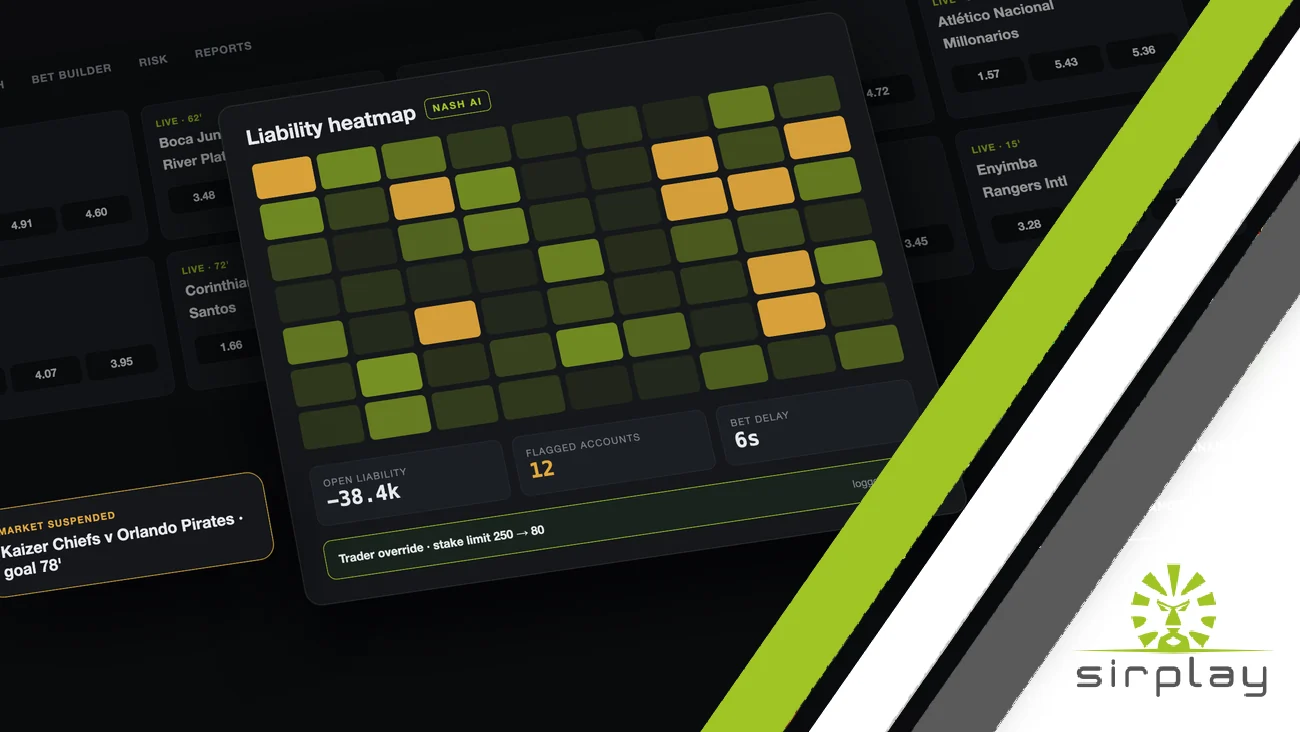
Buying sportsbook software is buying control over risk. The odds feed, the bet builder and the front end matter, but margin is decided by whoever sets limits, prices live markets and can refuse a bet. This guide turns that into five criteria you can score in any vendor demo.
It is written for licensed bookmakers comparing a white label betting platform or a sportsbook engine to plug into an existing stack. Sirplay is one of those vendors; the criteria apply to all of them, Sirplay included. Licensing, KYC/AML and player funds stay with the operator in every model described here.
Who this guide is for
This guide is for the Head of Trading, COO or CTO of a bookmaker that is already live, or about to be, and has to choose or replace a sportsbook provider. It assumes you know what a bet slip is and what liability means.
If the delivery models are still unclear, first read what a white label in betting includes. This guide starts where that one ends: you know what you are buying, now you need to know how to tell vendors apart.
If you are looking for betting tips or a bonus, this page is not for you. Sirplay supplies software to operators and does not take bets from players.
The five criteria that decide margin
Five things separate sportsbook platforms once the marketing is removed: how combinations are built and priced, how fast live prices move, who controls risk, whether retail and online share one account, and what the go-live clock actually counts.
Feature lists hide this. Every vendor lists a bet builder, live betting and a risk module, so the difference sits in who controls each of them after go-live. The sections below give the question to ask for each one, and the evidence to request in the demo instead of a slide.
Bet builder: player-built combos or curated combos
A bet builder lets a bettor combine several markets from the same event into one priced bet. Because the legs are correlated, the price must account for that correlation, or the book sells combinations below their true probability.
Two different products are sold under the same name:
- Player-built same-game combinations. The bettor picks the legs and the engine prices them in real time with a correlation model. Popular, high margin when priced well, expensive when priced badly.
- Curated combos. Traders build ready-to-play combinations and promote them on the sportsbook home page. The trading team controls exposure, but the bettor’s choice is narrower.
Sirplay’s sportsbook describes the second model: traders create combos and highlight them on the home page. Ask every vendor which of the two they sell, on which sports, pre-match only or also in play, with how many legs, whether cash-out works on builder bets, and how a void leg is settled. A vendor who answers “we have a bet builder” without these details has answered nothing.
Live betting: latency is a risk number
Live latency is the time between an event on the field and the new price reaching the bet slip. Every second of delay opens a window in which a better-informed bettor can beat the price. Latency belongs in the risk model, not in the UX checklist.
Volume is the number vendors like to show. Sirplay states 150,000 pre-match events across 80+ categories and more than 100,000 live events a month. Treat any such figure, ours included, as a claim to test, not as quality. The useful questions are narrower:
- Which live events are actively traded, and which are only fed?
- How fast are markets suspended on a goal, a red card or a break point?
- Can bet delay be set per sport, per market and per customer?
- What happens to pending bets when the feed drops?
The best test costs nothing: watch a live match in the demo next to a fast stream, and time the suspension yourself.
Risk management: your own arms or someone else’s
Sportsbook risk management is the set of controls that limits liability per event, market and customer: stake limits, customer profiling, price moves and the right to refuse or delay a bet. It decides margin more than any odds feed does.
Machiavelli warned rulers that power resting on someone else’s arms lasts only as long as those arms stay loyal. A sportsbook whose risk sits in a vendor’s black box is in the same position: margin depends on rules the operator cannot see or change.
Three models exist in practice:
- Manual trading desk. Traders watch exposure and act. Precise on big events, slow at scale, expensive at night.
- Rules engine. Static thresholds per market and customer group. Predictable, but it only knows what someone wrote into it last month.
- AI-assisted risk. Models flag patterns, profile customers and suggest limits. Nash AI is Sirplay’s module of this kind. Sirplay’s product page states that operators use these tools on about one million bets a day.
What AI can do: see patterns across volume no desk can read, react at 3 a.m., and learn the team’s limits. What it cannot do: judge breaking news, set the operator’s commercial appetite, or carry the liability. The liability stays on the book, unless a winnings-coverage service is contracted separately, which is a different agreement with a different price.
Ask: who sets the limits, can my traders override every automatic decision, is there an audit log of each override, and does the model learn our rules or impose the vendor’s?
Retail and online: one wallet or two businesses
An omnichannel sportsbook runs shops, self-service terminals and online on one player account, one wallet and one risk view. Without that, retail and online become two books that hedge against each other without knowing it.
This matters most in Latin America and Africa, where cash and agent networks still move a large share of handle. Ask whether a bet placed in a shop and one placed on mobile count against the same customer limit, how cash is reconciled per agent, whether terminals are certified for your jurisdiction, and whether a retail customer can withdraw online. If the answer to the first question is “two systems”, you are buying two risks.
Go-live time: what the clock really counts
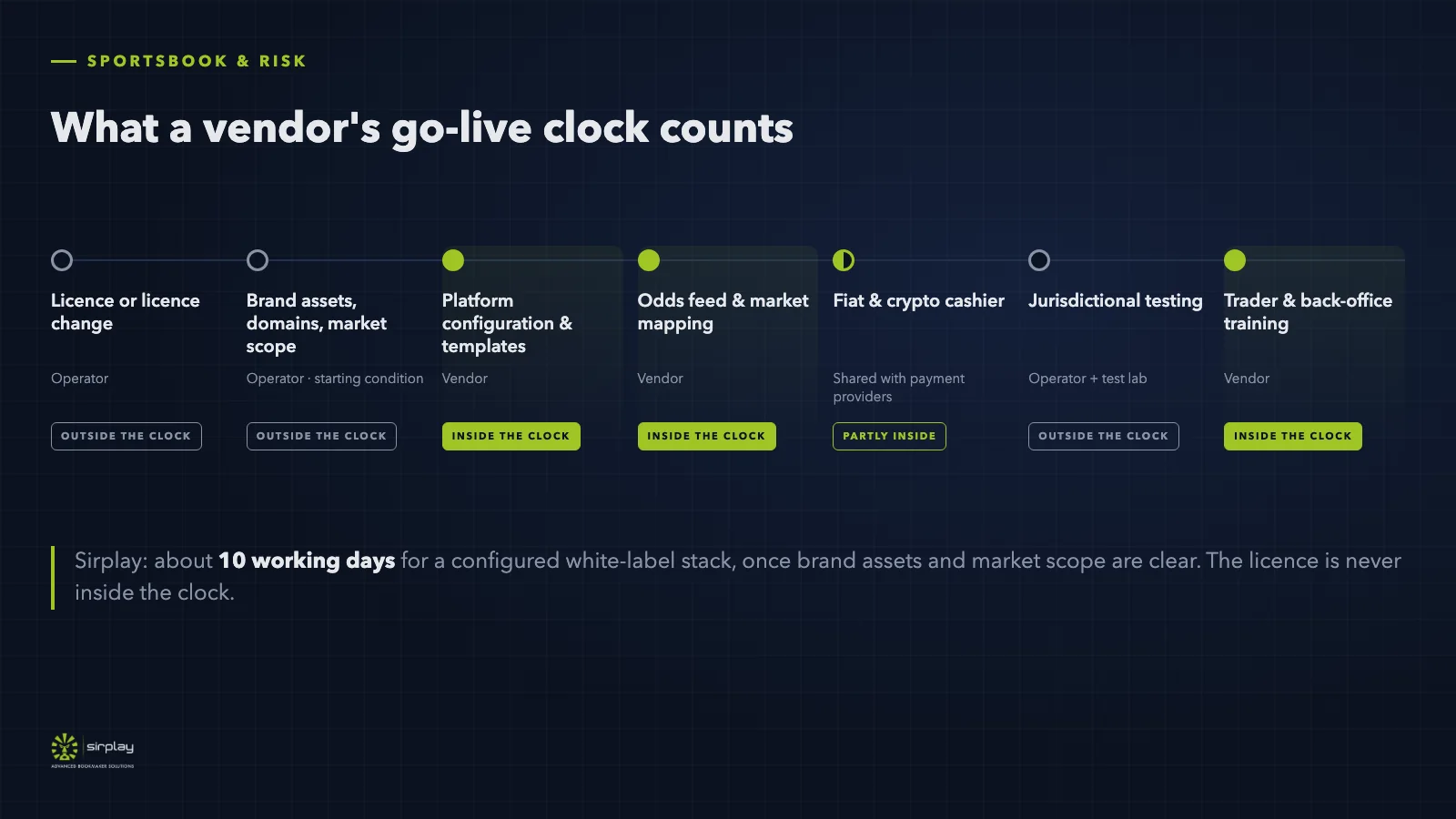
Go-live time is the period from signed scope to the first real bet. Vendors start the clock at different points, so a “ten days” and a “twelve weeks” quote may describe the same work. Ask which steps sit inside the clock.
Sirplay’s figure is about 10 working days for a configured white-label stack, once brand assets and market scope are clear. That is a real number, and a narrow one. It does not include the licence, which runs on the regulator’s calendar.
| Step | Who owns it | Inside the vendor’s clock? |
|---|---|---|
| Licence or licence change | Operator | No |
| Brand assets, domains, market scope | Operator | No: it is the starting condition |
| Platform configuration and templates | Vendor | Yes |
| Odds feed, markets and sport mapping | Vendor | Yes |
| Fiat and crypto cashier integration | Shared with payment providers | Partly |
| Jurisdictional testing and certification | Operator and test lab | No |
| Trader and back-office training | Vendor | Yes |
The vendor who wins on go-live is not the one with the smallest number. It is the one whose number still holds when you add the rows marked “no”.
Delivery model and certification
White label, turnkey and iframe decide how much of the stack you run yourself. A white label is the most managed option: the vendor runs the platform, feeds, payments and risk services under your brand. A turnkey sportsbook gives you the complete site and back office to operate with your own trading and operations team. An iframe or API integration drops the betting engine into a player account system you already run. Choose by who will run the platform on day 30, not by who launches it on day one.
A lab certificate covers a specific product version tested against a specific standard for a specific jurisdiction. It does not certify a company or every market. Sirplay’s sportsbook is multi-lab certified, tested by GLI and BMM; ask any vendor, us included, for the certificate itself: product, version, standard, jurisdiction and date. ISO/IEC 27001 covers information security management, not the fairness or the pricing of the book.
The evaluation matrix
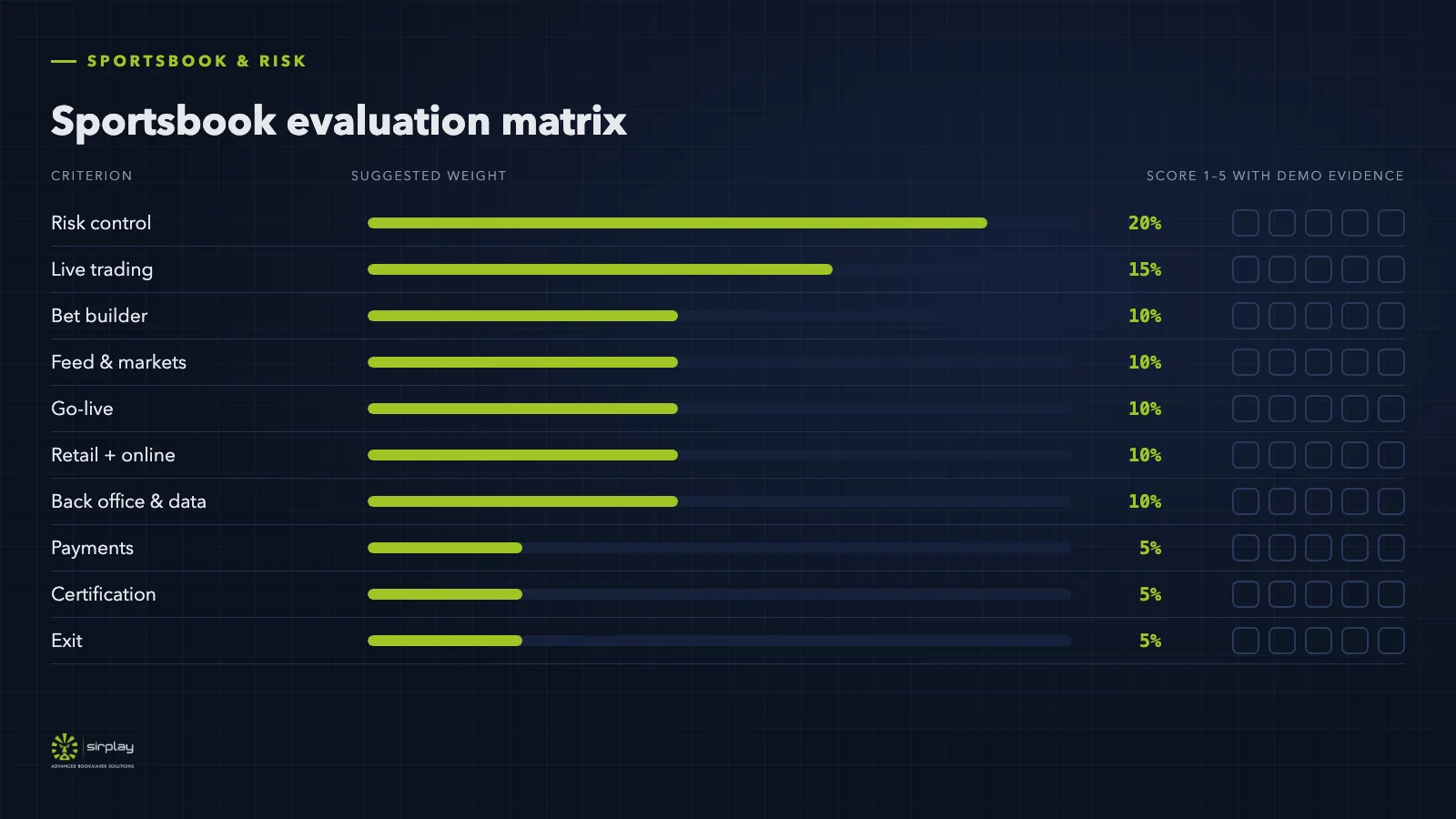
Score each vendor from 1 to 5 on each row, with the evidence you saw in the demo, not the one you were promised. Weights are a starting point; change them to match your market.
| Criterion | Question that decides it | Evidence to ask for | Suggested weight |
|---|---|---|---|
| Risk control | Who sets and overrides limits? | Live override in the back office, audit log | 20% |
| Live trading | How fast are markets suspended? | Timed suspension on a live match | 15% |
| Bet builder | Player-built or curated? How is correlation priced? | A priced builder bet and its settlement rules | 10% |
| Feed and markets | Which events are traded, not just fed? | Coverage list per sport, live vs pre-match | 10% |
| Go-live | What is inside the clock? | Written plan with owners per step | 10% |
| Retail + online | One account and one limit across channels? | One customer, two channels, one limit | 10% |
| Payments | Fiat and crypto on the same wallet? | A deposit in each, same account | 5% |
| Back office and data | Can I export raw bet data? | An export in the demo | 10% |
| Certification | What exactly is certified? | The certificate document | 5% |
| Exit | What happens to players and data if we leave? | The contract clause | 5% |
For crypto depth on the same book, Sirplay’s Web3 stack connects external wallets to the bet slip; score that row only if crypto is in your licence. Download the matrix as a spreadsheet: sportsbook evaluation matrix (CSV).
What Sirplay covers, and what stays with you
Sirplay has supplied sportsbook software since 2005 and states 40+ bookmakers in 11 countries as customers. It supplies the betting engine, feeds, back office, risk tools including Nash AI, and white-label, turnkey or iframe delivery. It does not supply the licence, the player-fund accounts, or the commercial decision on how much risk your book should take. Those decide whether the business survives, so they stay where the licence is.
Questions operators ask
Five things: who controls risk limits, how fast live markets are suspended, how the bet builder is priced, whether retail and online share one account, and what the go-live clock includes. Feature lists look the same across vendors; control does not.
Not always. A same-game parlay is built by the bettor and priced with correlation in real time. Some platforms call trader-curated combinations a bet builder too. Ask which one you are buying.
No. AI risk tools such as Nash AI read patterns at volume and react faster than a desk, but they do not judge news, set commercial appetite or carry liability. They make a smaller team stronger; they do not remove it.
With Sirplay, a configured white-label stack goes live in about 10 working days once brand assets and market scope are clear. The licence and local certification run on their own timelines and come first.
No. A lab certificate confirms that a product version was tested against a standard. The gambling licence belongs to the operator and is issued by the regulator.
Yes, through an iframe or API integration. The betting engine plugs into the existing player account and wallet; risk and trading remain separate controls.
Next step. Bring your monthly bet volume, your markets and your current provider’s weakest point to a demo. We will show you the override screen first. Request a demo