

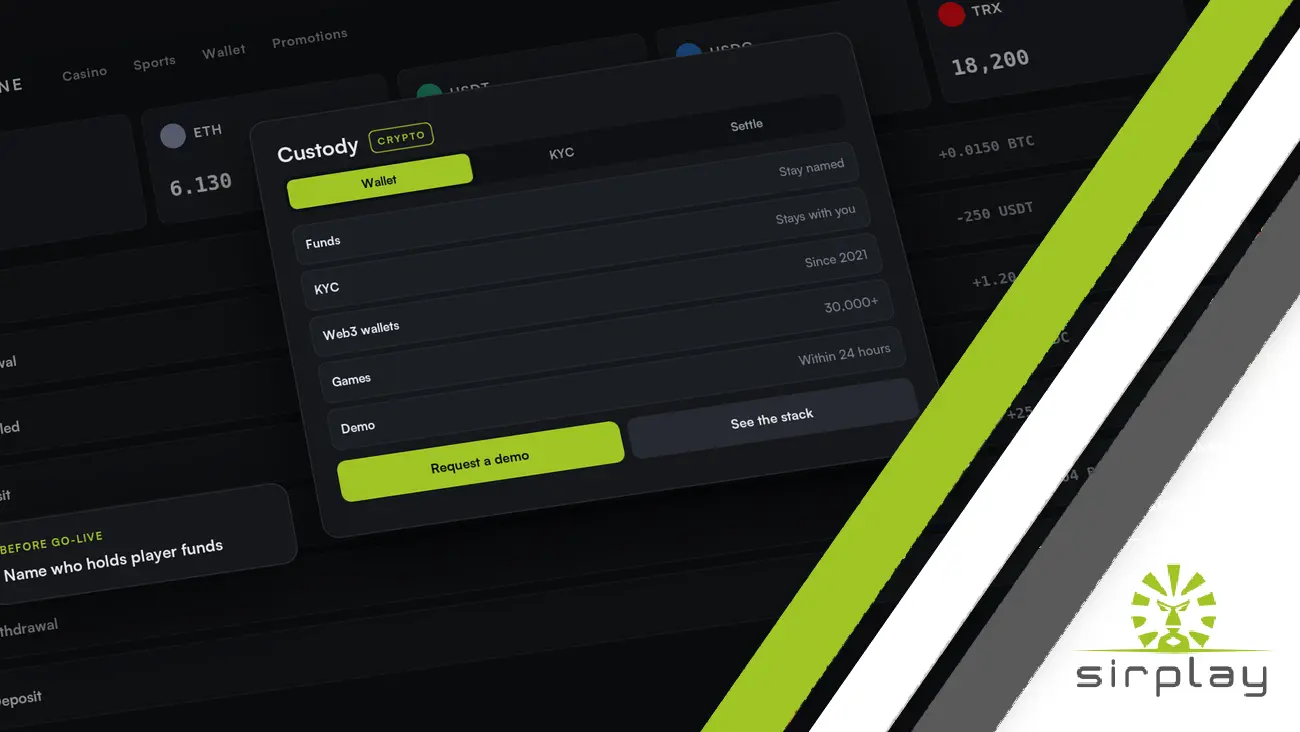
A licensed operator who buys crypto casino software is buying a way to take coin deposits and pay withdrawals from a controlled book. The operator is not buying a licence, a bank account, or permission to skip identity checks. Three questions come before the token list: who holds the player funds, who screens the wallets, and which registration covers settlement. If the answer to any of them is the software company, the purchase is not ready. Crypto casino software can open a cashier and pass a transaction to a rail. It does not take the operator’s name off the licence.
Sirplay sells this software to licensed operators. Founded in 2011, the company has more than 15 years in the market and more than 130 clients in 22 countries across Latin America, Europe and Asia. What follows is a buying brief, not a legal opinion, and not an offer of anonymity.
Who holds the player funds
A dollar token still leaves a balance with a named party. That party may be the operator, a custodian the operator appoints under its own licence, or a payments firm the licence already names. It is not an unnamed wallet inside a software contract. Sirplay is a B2B supplier: it does not step into the operator’s place as the holder of player funds.
The question matters more as stablecoins take over the cashier. According to How the Stablecoin Shift Is Reshaping Crypto Gambling, a report published by iGB with RYKI on 3 November 2026, dollar stablecoins now account for about 75 percent of crypto casino deposits, and USDT and USDC together make up 89 percent of stablecoin gambling transactions. A reviewer will still ask who holds the funds, and that question stands however the stablecoin share moves.
Ask for the legal entity, the wallet or account that entity controls, and the clause that says what happens to the balance if the contract ends. The token on the receipt is the easy line. The name that can move the balance is the line that matters. Machiavelli judged a court by the names around the prince. A cashier is judged by the name that can move the balance. Keep the names in the same file as the coin list. A cashier that accepts several assets but names only one holder is incomplete: each asset needs a holder, a screen and a settlement registration, even when the player sees a single balance.
Who screens the wallets
Screening is the check on the address and, where your rules require it, on the person allowed to use that address. A wallet signature proves control of a key. It does not prove age, country or source of funds. The operator keeps the duty to identify players. A processor can run a list and a custodian can refuse a transfer, but neither one becomes the operator.
Ask who runs the screen, which lists are in scope, and what a failed check does to an open session. Ask where the result is stored and who can export it when a regulator writes. A public ledger shows that value moved. It does not show that you knew the player. A second address or a second coin must not get around a block you meant to hold.
Sirplay has offered Web3 wallets since 2021. A connection of the kind described on the Web3 casino page lets players sign with a wallet they already hold. Keep that feature in its box: it is a deposit and withdrawal path, not identification, and not a promise that play is anonymous. If your procedure cannot tie the wallet to a person you are allowed to accept, do not open the games to that wallet.
Which registration covers settlement
Settlement is the movement from the player’s rail into the operator’s book, and back out again on a withdrawal. The registration that covers that movement has to be named. It may be the gambling licence, a payment permission, a virtual asset registration held by a firm you appoint, or more than one of these. Read the contract clause that names the entity, then the clause that names who broadcasts the transaction. If the names differ, you have a vendor and a principal, and the file should say so.
The regulatory backdrop is moving. In the EU, the MiCA transitional period for crypto-asset service providers ended on 1 July 2026. In the US, the GENIUS Act on payment stablecoins takes effect on 18 January 2027. The OCC said on 21 October 2026 that the Act and its final rule take effect on that date. This article is not legal advice, and a trade report is neither a reading of either regime nor permission to accept a coin in a given country. Ask counsel which registration covers settlement for each asset you plan to take, in each market you plan to serve, and put the answer beside the custodian’s name.
As a supplier, Sirplay states nine licences and four certifications, including testing by GLI and BMM and ISO/IEC 27001. Check those statements in due diligence. They describe the supplier: they do not replace the operator’s gambling permission, and they do not decide who may move player funds.
A no-KYC option does not identify your players
Some cashiers are sold with a no-KYC label. Read it as a note about one payment option. A no-KYC payment option does not remove the operator’s duty to identify players: where the licence requires an identity, age or source-of-funds check, the label does not cancel it. Nothing in this article promises anonymity, and no software page should be read as offering it. A sales pitch that says players can stay unnamed is a reason to end the meeting.
Keep the check on the operator’s side of the account, even when the coin arrives from an external wallet. The person who can deposit must be a person you are allowed to serve, and a country block on an IP address is not the same control as a check on the holder of the key. Write the difference down in plain language before the rail is switched on. Staff will ask for a manual release when a screen fails, so decide in advance who may approve it, what they must record, and which coins can never be released by hand.
What the software does and does not take over
Online casino software is the player account, the wallet logic, the lobby, and the reports the operator’s team runs. It is not a managed operation. The software can record a balance. The operator still decides whose balance it is, and under which rules that person may play.
Sirplay states more than 30,000 games. That is a catalogue figure, not a claim that every title is cleared for your market: lawful activation follows your licence and each studio’s own permission. Do not buy on the count.
In Sirplay’s offer there are two commercial models. White label means a build customised to the client’s specification. Turnkey means a build on Sirplay templates. Neither model moves the licence. You still hold the brand in the market, you still answer to the regulator, and you still own the player relationship. If a proposal blurs those lines, send it back.
Sirplay has offered a crypto sportsbook since 2017. More company background is on the about page. mybitcoin.casino is a licensed casino that runs on Sirplay’s platform, while sirplay.bet and rex.games are demos. Use a demo to see a flow, not as proof that your custodian, your screening or your settlement registration is in place.
What to close before you ask for a demo
Before anyone opens a demo, write the three names on one page: who holds player funds, who screens wallets, and which registration covers settlement. If a line says “the vendor”, replace it with a legal entity. If a line says “to be confirmed”, you can still look at the product, but you cannot treat go-live as a date.
A demo can be arranged within 24 hours, and a turnkey build takes about 10 working days once the brand and markets are defined. The licence is never part of those 10 days: counsel, the custodian agreement and the screening procedure run on their own clocks.
Bring your market list and brand rules to the call, and leave with a short note of what the software records and what stays with you. Request a demo once those three names are at least drafted, and judge the stack against the duties you will not hand over.
No. The software can record a balance and pass a transaction to a rail. The holder is a legal entity you name in the contract and on the licence. Sirplay sells B2B software to licensed operators and does not take that place.
No. A no-KYC label describes one payment option. It does not cancel the identity, age or source-of-funds checks your licence requires. It is not anonymous, and it does not move the duty off the operator.
The operator keeps that duty. A custodian or processor may run a list under the operator's instruction, but you still need a named owner, a failed-check path, and a record you can export when a reviewer asks.
In Sirplay's offer, white label means a build customised to the client's specification, and turnkey means a build on Sirplay templates. Neither hands the licence to the provider: the operator keeps the licence, the brand in the market, and the player relationship.
A demo can be arranged within 24 hours. A turnkey build takes about 10 working days once the brand and markets are defined. The licence is never part of those 10 working days.