

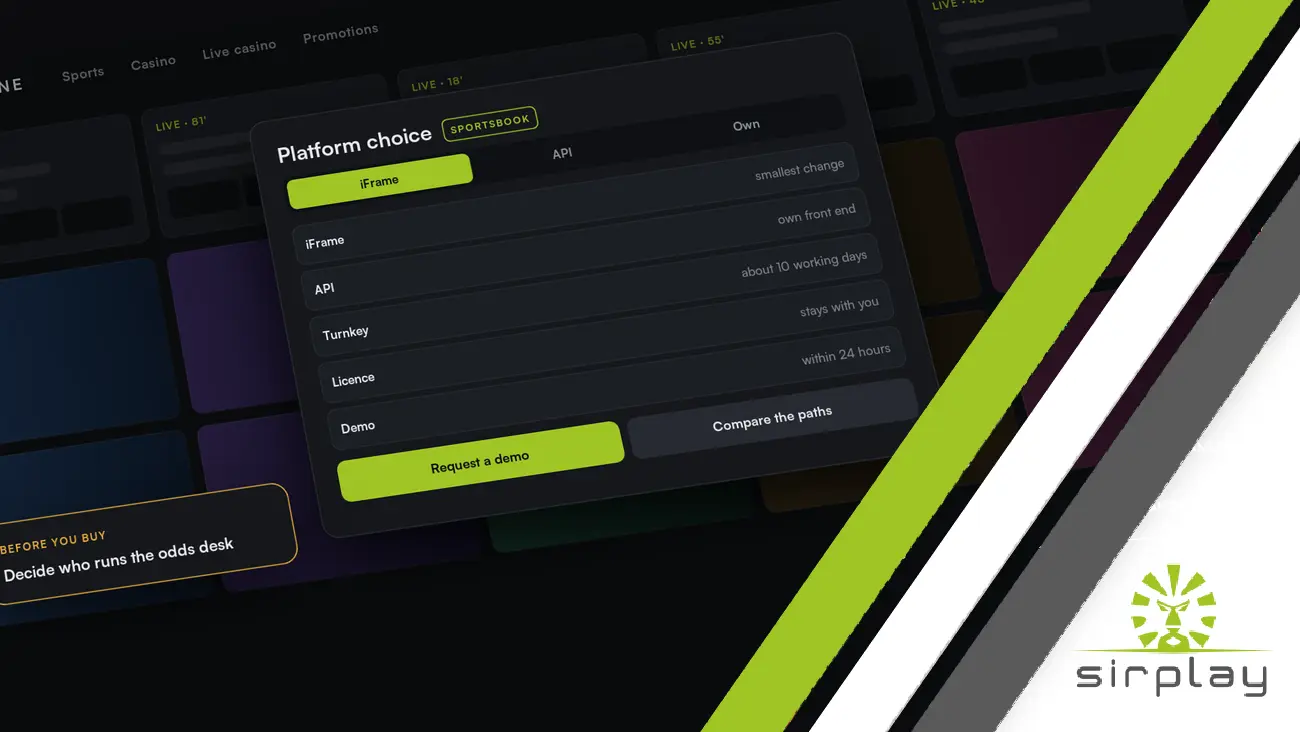
A licensed operator should choose a sportsbook platform provider by the size of the change it needs, not by a ranking of logos. There are three common models: an iFrame, when the player account already exists and the change should stay small; an API, when the operator wants its own front end on someone else’s odds, risk and wallet; and a full platform, when the operator’s team can own the day-to-day. None of the three is a score, and none of them sets a margin or a GGR figure. For the product itself, start from the sports betting software page, then come back to the choice.
What the three models decide
In this frame, a sportsbook platform provider is the party that supplies the bet screen, the prices, the risk checks or the day-to-day desk, while the licensed operator keeps the right to offer the bet.
- iFrame. A supplier screen inside a site that already knows the player. Betting is added without rebuilding registration, the cashier or the account.
- API. The operator’s own pages and navigation, with prices, risk decisions and wallet movements coming from another party.
- Full platform. Named people on the operator side open the desk each day, and limits, reports and settlement questions all have an owner.
All three are ways to add or replace a sportsbook. Any claim about speed or revenue belongs to the firm that makes it, not to your calendar or your trading results. Compare who holds the account, who builds the front end, and who can change a price at night.
An iFrame when the change stays small
An iFrame sportsbook is a supplier-rendered bet screen embedded in a site that already has a player account, so betting can be added without replacing registration or the cashier.
Use it when the account should stay where it is. The frame adds events, markets and a bet slip to a page you host. Session, currency, stake and bet ID need a written mapping: if the frame and the account disagree, one brand gives two answers, and support is the first to notice. Much of the layout and many of the risk settings stay with the supplier. That suits a small team, but it falls short when the brand needs a front end no other site has, or when traders must change a limit on their own schedule. Your timeline still depends on the account, the sports and the licence you hold: a smaller screen does not make licensing any faster.
An API when the front end is yours
A sportsbook API lets the operator build its own front end while another party provides the odds, the risk decision and the wallet movement behind the bet slip.
It suits a team that is ready to staff the screen. The player uses your pages, but the price, the acceptance or refusal, and the balance update come from outside. You own the look, not the desk, unless the contract says otherwise. Before you treat the API as independence, the contract needs three lines:
- Odds. Who compiles the price, who suspends a market, and what stops a bet when the result is already known.
- Risk. Who sets the stake cap, who may override a refusal, and which log records the action.
- Wallet. Who moves the balance, and which registration covers settlement. The interface does not come with a licence.
An API works well if you want your own front end without a pricing desk on the payroll. It ages badly if every limit change has to wait for another release, while your traders are the people the regulator will call. Ask to see the calls that price a bet, refuse a bet and post a balance. If those calls are missing, the front end is only a picture.
A full platform your team can run
A full platform is sportsbook software the operator’s team uses for limits, reports and settlements, with a written split between what the supplier does and what the operator controls.
Choose it when your team can own the day-to-day: a person working under your licence can open a bet, see why it was accepted, change a limit and export the record.
Sirplay sells this kind of platform as B2B software for licensed operators. In the market since 2011, it serves more than 130 clients in 22 countries across Latin America, Europe and Asia. Its sportsbook covers more than 100,000 live events a month, more than 150,000 pre-match events and over 80 sports, alongside a casino catalogue of more than 30,000 games. Sirplay lists nine licences and four certifications, with GLI and BMM testing and ISO/IEC 27001. These credentials qualify the supplier. They do not authorise you to take bets.
Sirplay offers two routes. Turnkey puts your brand, colours and domain on Sirplay templates: once the brand and markets are defined, setup takes about 10 working days, and a demo can be requested within 24 hours. White label is the same platform customised to your specification, so the timeline depends on the scope of that work. For the custom route, see the white label betting platform page. Either way, you still need a team, and the operator still names who runs the desk.
Trading can be handled by Sirplay as a service or by the operator’s own team. When your team runs the sportsbook desk, Nash AI applies the limits the team sets, records every automatic action in an audit log, and keeps a manual override with the traders. It does not promise results. Promotions are configured in the bonus engine, with the budget and the rules set by the operator.
Who can still act after you sign
The model in the contract is only as real as the person who can still change a price, stop a bet, and walk away with the records when the relationship is under strain. Machiavelli would put the test in one line: who can still act after the signature, without asking the other side for permission.
| Area | Owner | What to write down |
|---|---|---|
| Licence | Operator | Countries, products and the legal entity. Never part of a go-live timeline. |
| Account integration | Operator | What an iFrame or API may read, and what it must not change. |
| Odds and risk | Your team, or Sirplay as a service | Who sets limits, who may override, and where the audit log lives. |
| Day-to-day | Named roles | Who suspends a market, who handles settlement queries, and who exports the list. |
| Exit | Operator | Domain owner, export format, and which screens you can still access. |
Anything a supplier tells you, Sirplay included, is a claim to test against this table. The company background is on the about Sirplay page. Ask for a run-through on a demo environment, not a client’s live back office: compile a price, accept a bet within a limit, refuse one outside it, override with a reason, and export the log.
What to settle before the demo
Before anyone discusses a date, name the owners of the account, the front end, the odds, the risk and the licence.
- Choose the model: iFrame, API or full platform. If you expect to move later, say which comes first.
- List what must stay: account, cashier, domain, and the markets you will open.
- Name the people: who compiles odds, who sets limits, and who may override a refusal.
- If you choose Sirplay: decide between templates and a custom specification. The 10-day count starts only once brand and markets are defined, and licensing runs on its own track.
- Decide on trading: your own team or a Sirplay service, and where the Nash AI limits are stored.
- Judge the demo on what it shows, not on revenue promises: ask which tasks it will cover.
Once the list has names on it, request a demo. The form records your request. It does not book a slot, and it does not grant a licence.
An iFrame, when a player account already exists and the change should stay small. An API, when the operator wants its own front end on someone else's odds, risk and wallet. A full platform, when the operator's team can own the day-to-day.
No. In every model the licence stays with the operator. An iFrame changes where the bet screen sits, not the legal entity that offers the bet. A supplier's own licences, including Sirplay's nine, do not replace the operator's.
When the front end has to belong to the operator: the pages, the navigation and the bet slip inside the brand. Odds, risk and wallet movements stay with the other party unless the contract moves them. If those three owners are not named, the API is still only a picture.
About 10 working days once the brand and markets are defined, using Sirplay templates. A demo can be requested within 24 hours. Licensing is separate and is not included in that timeline. White label, customised to the client's specification, takes as long as the custom work requires.
Nash AI applies the limits the trading team sets, keeps an audit log, and leaves a manual override with the traders. Trading can be run by Sirplay as a service or by the operator's team. Nash AI is a risk-management tool, not a promise of revenue.